SwimSafe
Background
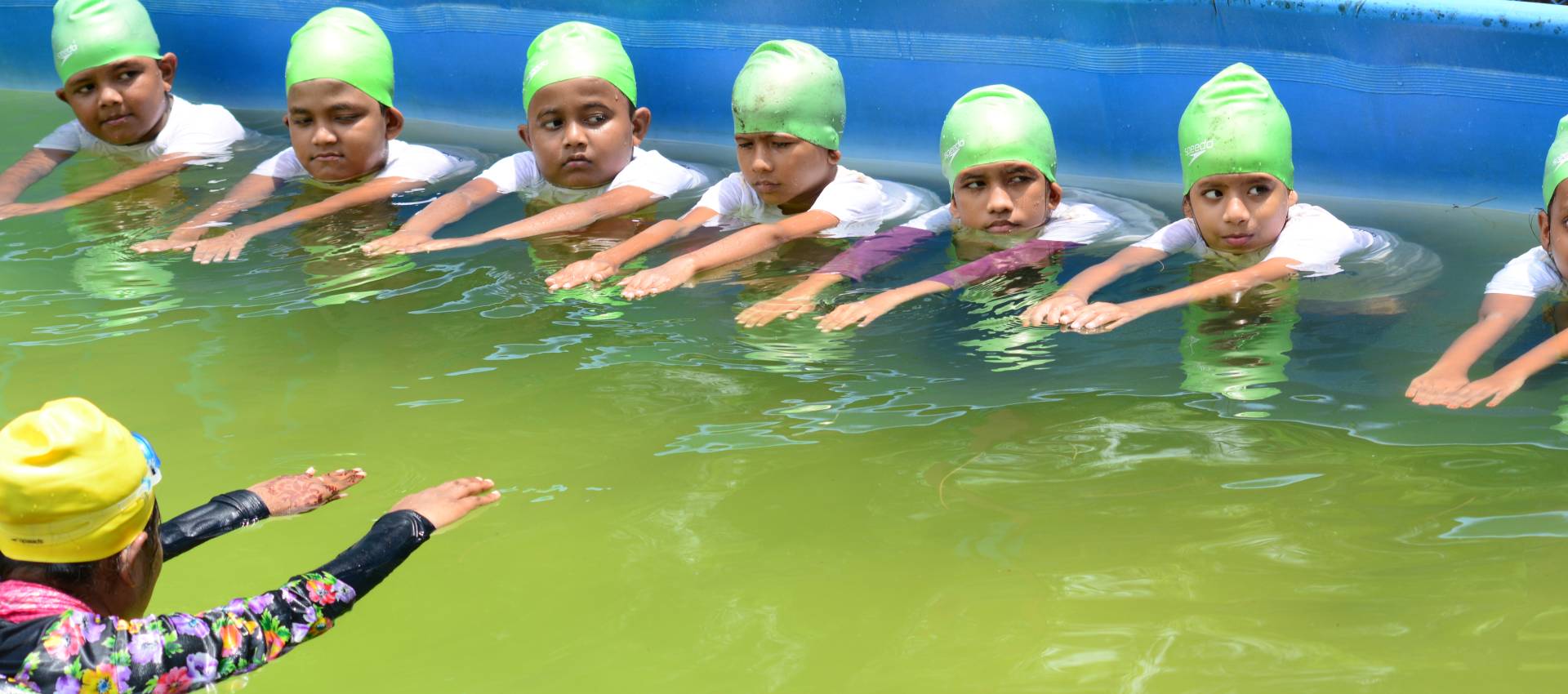
The ground breaking “Bangladesh Health and Injury Survey” revealed that drowning is the leading cause of death for children aged 1-17 year in Bangladesh, with approximately 18,000 children dying each year. Among them, over 12,000 are children aged 1-4 years and 5,000 drowning occur amongst the older age group 5 – 17 years. SwimSafe is an important programme for preventing drowning of older children. Through the programme, children learn survival swimming and rescue techniques.
Development of SwimSafe program
CIPRB developed SwimSafe programme in collaboration with Royal Life Saving Society Australia (RLSSA), The Alliance for Safe Children (TASC) and Bangladesh Swimming Federation in 2005. Since 2006 CIPRB has been conducting SwimSafe programme with the financial assistance from UNICEF. RLSSA, TASC and CIPRB supported Thailand and Vietnam to develop similar survival swimming programme SwimSafe.
Copy right
“SwimSafe” is the copy right survival swimming programme of CIPRB in Bangladesh, Da Nang Safe Project in Vietnam and TASC and the partner organizations in Thailand.
Implementation of SwimSafe program in Bangladesh
The CIPRB has been implementing the SwimSafe programme in different locations in Bangladesh since 2006. During 2006 to 2008, the programme was active in three PRECISE upazilas, namely, Raiganj, Sherpur Sadar and Manohardi, and in Mirpur, Dhaka. During 2009 and 2010, CIPRB collaborated with BRAC and CMES to expand the programme in 17 rural upazilla of the country and in Mirpur, Dhaka. In 2012 year SwimSafe program is running in Rangpur, Sirajgonj, Khulna, Jamalpur, Netrokona, Borguna, Cox’s Bazar and in Dhaka city Bangladesh. From 2006 to 2011 total 213,985 children learn survival swimming skills among them 116,334 are boys and 97,651were girls.
Effectiveness of the SwimSafe programme
To measure the effectiveness of the SwimSafe programme, CIPRB conducted a cohort study in 2010. A total of 54,834 SwimSafe participants were selected as cases and another 54,834 non SwimSafe participants were selected as the controls. It was found that drowning death among the SwimSafe participants were 1.06 and among the non SwimSafe participants were 23.17 per 100,000 children. The study showed that SwimSafe is a protective measure to prevent drowning. It was revealed that SwimSafe graduates had 96% less chance of drowning than the non-SwimSafe participants (RR 0.46; 95% CI 0.037 -0.071).
Targeted children
All children aged 4- 10 years old who can not swim or do not meet the survival swimming criteria of 25 metres swimming and 30 seconds treading and rescue skills will be eligible to be enrolled in the SwimSafe programme.
SwimSafe venue
Rural area: In rural areas, children learn swimming in modified pond. A diagram of the modified pond is given below.
Urban area: In urban areas (Dhaka), children learn swimming in swimming pools of Bangladesh Swimming Federation (BSF) and International Drowning Research Centre-Bangladesh.